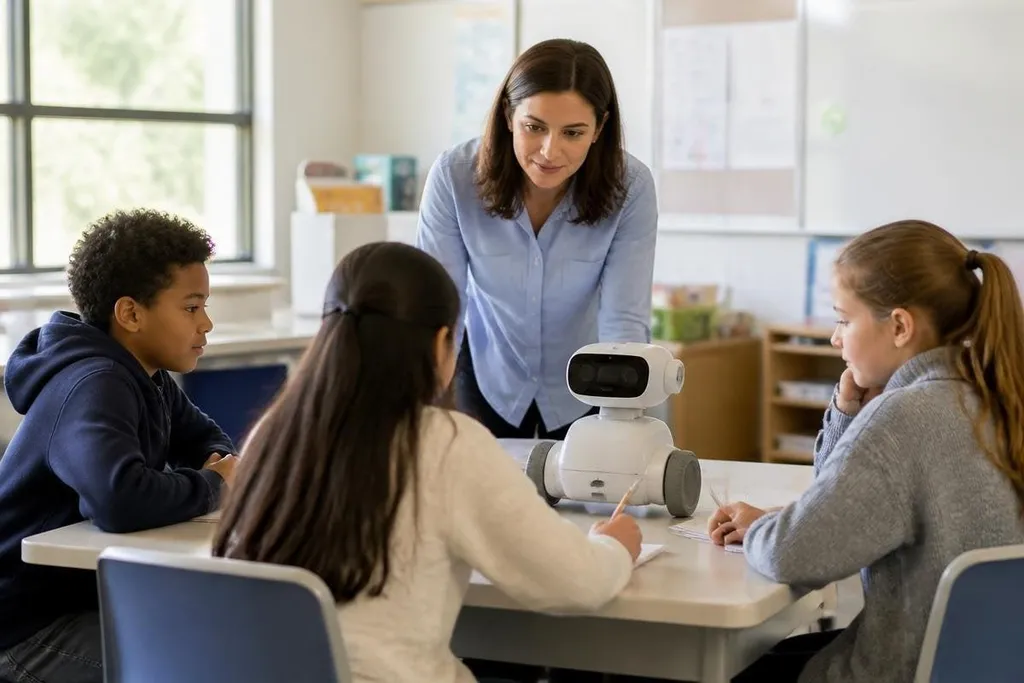
An educational robot could give each student a different task after watching how they solve the last one. That sounds useful, but the value depends on what the robot can measure and what the teacher can change.
- A robot can adjust pace, hints, and practice tasks.
- Voice, movement, and test scores can give partial clues about learning.
- Teachers still need to check the robot’s choices and protect student data.
What personalization could look like
A classroom robot might present the same lesson to a group, then change the next activity for each student. One learner may need another worked example, while another may be ready for a harder problem.
The robot could track answers, time spent on a task, requests for help, and repeated errors. Those signals can guide the next question.
They cannot fully explain why a student is stuck, though. A child may be tired, distracted, worried, or unfamiliar with the language used in the lesson.
That limit matters. A wrong answer is a clear result, but the reason behind it needs human judgment. The robot should suggest a next step, not label a student’s ability from a small set of actions.
The robot’s useful jobs
Personal learning systems work best when the robot handles repeatable parts of teaching. It can ask practice questions, read a short passage aloud, give a hint, or repeat an exercise without showing impatience.
A physical robot adds signals that a laptop cannot. It can turn toward a student, point at an object, move a block, or show a step with its arms. Those actions may help with early reading, language practice, coding lessons, or basic science tasks when the robot’s movement matches the lesson.
The design still needs care. A moving robot can distract from the task, and a spoken answer can be hard to understand in a noisy room. Teachers need controls for volume, speed, task level, and the type of help the robot gives.
A classroom robot’s learning claim needs a record of the task, age group, lesson time, and teacher’s role. Reports on educational robots from Robot24.com can tie those details to named systems and test dates before the next section looks at where classroom trials can fail.
Where the system can go wrong
A robot may read silence as confusion or fast answers as strong understanding. Neither conclusion is safe on its own. The system needs several signals and a clear way for a teacher to reject its suggestion.
Privacy creates another limit. Learning records can include names, voice data, images, scores, and notes about behavior. A school should know what the robot stores, how long it keeps the data, and who can view it before the machine enters a classroom.
There is also a social risk. If a robot gives easier work to a student after a few poor answers, that choice may reduce practice instead of helping. The teacher needs to see the reason for each change and keep the power to set a higher target.
I’d use an educational robot as a practice partner, not as the person deciding what a child can learn.
What schools should check
A school team can test the idea with a narrow lesson before buying a large system. Check these points:
- Lesson fit: Pick one task where spoken prompts or physical objects add clear help.
- Teacher controls: Confirm that staff can change levels, pause the robot, and review its suggestions.
- Student data: List every recorded item, its storage time, and the people who can access it.
- Failure cases: Test wrong answers, silence, background noise, and more than one student speaking.
- Access needs: Check captions, speech speed, screen controls, and support for students with motor or hearing needs.
- Success measure: Choose a result the school can check, such as completed practice or fewer repeated errors.
That last point keeps the trial tied to learning instead of robot activity. A robot that moves often may look busy while adding little to the lesson.
The next useful test
The next step is a small classroom trial with a fixed lesson, teacher review, and a clear data limit. Schools should compare the robot’s suggestions with teacher decisions and student work before giving the system more control.